


Bid Whist Plus
Zynga
Bid Whist Plus is the kind of card game I would suggest to someone who enjoys learning a traditional trick-taking game but wants to play against an online community rather than rely on finding a table nearby. Developed by Zynga, it focuses on bid whist and presents itself as a social card experience instead of a solitary puzzle. I found the appeal strongest when I wanted a short, thoughtful session in which reading the bid mattered as much as the cards in my hand.
The game is free to install, and its audience is rated Teen. It has reached over 500 thousand installs, with an average rating of 4.3 from around 16 thousand ratings and roughly 4.9 thousand written reviews. Those figures suggest a healthy player base, although they should not be mistaken for a guarantee that every match will feel equally active or equally welcoming. My overall impression is positive, but this is a better choice for people who already like competitive card play than for anyone looking for a completely casual game with no learning curve.
Getting from the first screen to a meaningful game
What to expect when you begin
The first thing to understand is that Bid Whist Plus is not simply a digital deck where you tap cards until a round ends. The central challenge is the relationship between bidding and trick-taking. You are trying to judge the strength of your hand, decide how ambitious your bid should be, and then make choices that support that commitment. That makes the game feel more deliberate than many quick mobile card titles.
If you have never played bid whist, the opening minutes can feel dense. There are unfamiliar terms, a changing sense of which cards matter, and decisions that may not make sense until you see how a complete hand develops. I recommend resisting the urge to make aggressive bids immediately. A modest first round teaches you more than a dramatic gamble because you can watch how the bid changes the practical value of your cards.
The online focus also changes the mood. You are not only testing a strategy against a fixed computer opponent; you are entering a community built around a specific card game. That can be rewarding when you want to improve through repeated play, but it also means the experience depends on your patience with other players and with the pace of online matches. Someone seeking a quiet, entirely offline pastime may prefer a conventional solitaire or single-player card app.
Related News

Threads in Real Life: Who Should Join, Lurk, or Leave

How SHEIN Turned Shopping Into an Endless Content Feed

How to Make Fortnite Feel Smarter on Mobile

Should You Switch to Microsoft Outlook on Mobile?

Why Gallery Keeps Pulling Users Back

X Review: Why Its Network Still Matters
A sensible first setup
After installing the game, I would begin by moving through the introductory screens slowly rather than skipping everything. Pay attention to the vocabulary used for bidding, because remembering a term is easier when you connect it to the decision it affects. If the game presents a tutorial or explanation, treat it as a reference you can revisit, not as a test you must memorize in one sitting.
Before joining a serious-looking match, use the early play to observe the table layout. Identify where your hand appears, how the current bid is displayed, how tricks are collected, and where the score or round result is shown. These small visual details matter. When a card game becomes tense, you do not want to spend your attention searching for the control that confirms a bid or ends your turn.
I also suggest setting a simple personal goal for the first session: understand one complete hand from opening bid to final trick. Do not measure success only by winning. If you can explain why you made the bid, why you selected a particular card, and what the opposing play revealed, you have already made useful progress. That approach keeps the first experience from becoming frustrating when the result goes against you.
Gallery
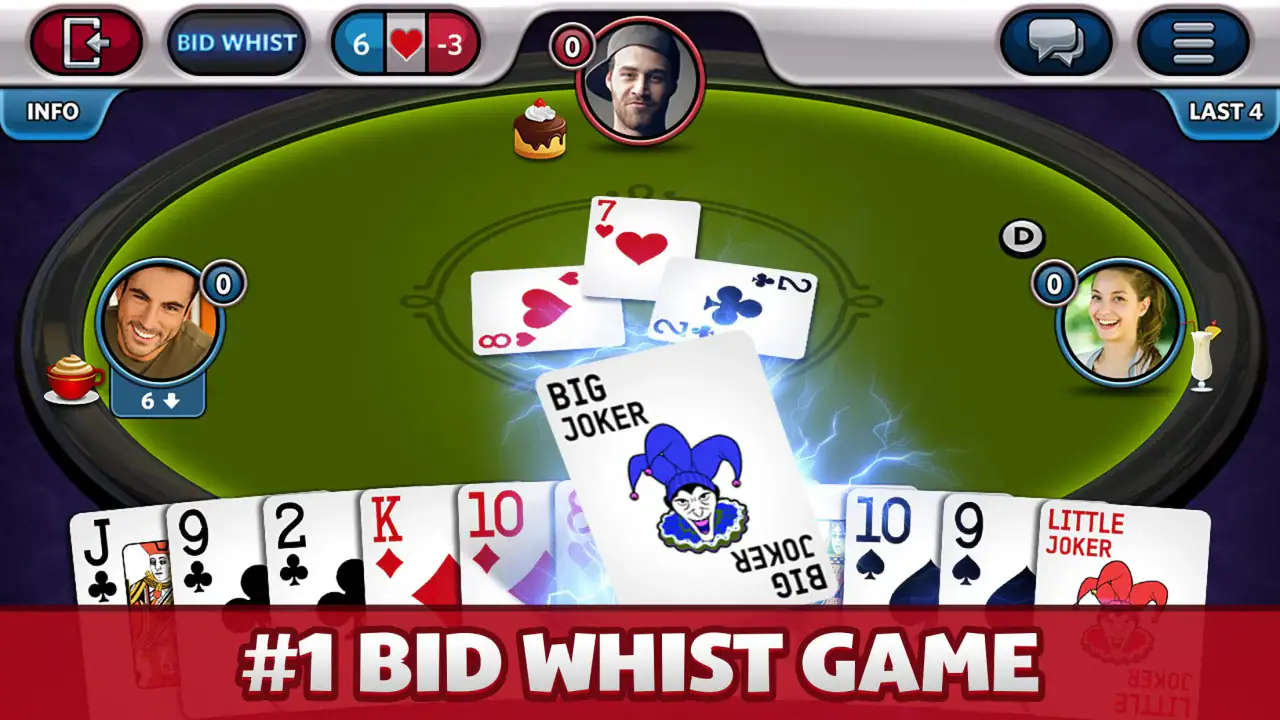
The game is available without an upfront purchase, but it includes optional in-app purchases ranging from $0.99 to $199.99 per item. I would not spend anything during the learning stage. First determine whether you enjoy the core card decisions and the rhythm of online play. A free entry point is valuable here because bid whist is a specific taste, and no purchase can replace understanding whether the game itself suits you.
Your first successful action
For a new player, the first meaningful success is not necessarily taking the most tricks. It is making a bid that matches the hand and then playing toward it without panicking when an opponent takes an early trick. I found that a conservative plan works best at the beginning: look for the strongest patterns in your hand, avoid promising more than you can reasonably support, and keep track of which important cards have already appeared.
Once play starts, do not treat every trick as an isolated choice. Ask what the current trick tells you about the remaining hands. If a suit is being played repeatedly, notice who seems comfortable following it and who may be running out of options. If a high card disappears early, update your expectations instead of continuing with the original plan. This habit is more valuable than memorizing a long list of rules.
A practical routine helped me: before each turn, identify the immediate objective, then consider the consequence for the next trick. Sometimes the right move is to win now; sometimes it is better to preserve a card that could control a later exchange. The game rewards that kind of patience, which is why it feels more satisfying after a few sessions than during the first hurried attempt.
When you complete a round, review the result while the decisions are still fresh. If your bid failed, ask whether the mistake happened before play began or during the card choices. A poor bid and a poor follow-up require different corrections. Separating those two problems stops you from blaming every loss on bad luck and gives you something concrete to improve in the next hand.
Confusion that catches new players
The biggest source of confusion is usually the difference between having attractive cards and having a hand that can reliably fulfill a bid. A hand may contain several individually strong cards but lack the structure needed to control enough tricks. New players often see one impressive card and become overconfident. I learned to judge the hand as a whole, including how comfortably it can respond when the opponents change the direction of play.
Another common mistake is focusing only on the card currently being played. Bid whist rewards memory. You do not need perfect recall of every card, but you should remember the important ones: cards that have already won, suits that appear depleted, and signals that an opponent may be protecting a stronger option. Even a rough mental record makes later decisions clearer.
It is also easy to confuse a temporary setback with a failed strategy. An opponent taking an early trick does not automatically mean your bid is lost. Some hands develop slowly, and the value of a card can change as the available suits narrow. I recommend finishing the plan unless new information clearly makes it impossible. Abandoning a sound approach after one disappointing play usually creates more problems than it solves.
Online card communities bring a separate kind of uncertainty. A player may move faster than you expect, use unfamiliar conventions, or appear to make a choice you would not make. Rather than copying every surprising move, concentrate on learning the underlying outcome. Ask yourself what the play accomplished. That keeps the social element interesting without turning every match into a source of irritation.
There is another practical issue for first-time users: the game can feel less rewarding if you enter with the expectation of instant mastery. Bid whist has enough terminology and tactical depth to require repetition. If you prefer games that explain every decision clearly and offer immediate rewards, a simpler card game may be a better introduction. Bid Whist Plus is more suitable when you enjoy gradually building confidence through hands that initially seem difficult.
How I would approach the next sessions
After the first successful round, I would narrow the learning process to one skill at a time. For one session, focus on making more accurate bids. In the next, concentrate on remembering which cards have left the table. Later, work on recognizing when to conserve a strong card instead of spending it immediately. This is more manageable than trying to improve every part of your play at once.
A useful everyday scenario is a short evening break. I might start a match expecting a relaxed few minutes, but I would still check whether I have enough attention for a strategic game. If I am distracted by messages or trying to rush between tasks, I am more likely to miss the significance of a bid or play automatically. The game works best when I can give each hand a little focus, even if the session itself is brief.
For players who enjoy playing with friends, the social angle can make practice more motivating. You can discuss a questionable bid after a hand and compare how each person read the cards. That kind of conversation is especially useful for beginners because it turns an unclear loss into a discussion about alternatives. The community focus is one of the reasons this feels different from playing against an unchanging solitaire layout.
Compared with ordinary free card games, Bid Whist Plus asks more from the player before it becomes relaxing. Solitaire is easier to pause mentally, while a basic trick-taking game may offer a simpler ruleset. This title is the better choice when you want a recognizable card tradition with competitive decisions and online interaction. It is the weaker choice if you want a game that can be played with almost no explanation or if you dislike the pressure of committing to a bid.
The current version is 4.26.864, and the minimum operating system requirement is 7.1. Those details make it accessible to many older compatible devices, but I would still keep the app updated when possible so that the installed version matches the current online experience. The important point for a new user is that the game is not restricted to only the newest phones or tablets, which makes it easier to try before deciding whether it deserves a regular place on your device.
Who should try it, and who should skip it
I think this is a strong fit for anyone who already enjoys partnership card games, bidding systems, or the satisfaction of improving through repeated hands. It is also a good option for a player who wants more interaction than a solo card app provides. The free installation lowers the risk of experimenting, and the community-oriented design gives experienced players a reason to keep returning.
I would be more cautious recommending it to someone who has never played a trick-taking game and wants immediate, effortless entertainment. The learning curve is real, and the game becomes enjoyable partly because you learn to interpret information that is not obvious at first glance. Likewise, players who dislike optional purchases should remember that the app offers paid items, even though entering the game does not require an upfront price.
My most useful advice is to judge the game after you have completed enough hands to understand the basic cycle, not after the first confusing screen. At the same time, do not force yourself to continue if the bidding itself feels like work. Card games are personal: the same strategic depth that keeps one player engaged can make another player wish for a simpler format.
My recommendation after playing
Bid Whist Plus is best approached as a patient online card table, not as a disposable five-minute distraction. I like that its main challenge comes from reading a hand, committing to a plan, and adjusting as the tricks reveal more information. Zynga has made a free card game that can serve both as a way to reconnect with bid whist and as a place to practice against a wider player community.
Its limitations are tied to the same qualities that make it appealing. Beginners may need several sessions before the terminology and decisions feel natural, online play can be less comfortable when the pace or other players do not suit you, and optional purchases mean you should keep spending under your own control. None of those points makes the game a poor choice, but they do make the target audience clear.
If you want a thoughtful card game for Android or iOS that rewards memory, restraint, and better bidding rather than constant tapping, I think it is worth trying. Start slowly, learn the table controls, aim for one well-supported bid, and review the hand afterward. That path gives a first-time player a realistic chance to reach the satisfying part of Bid Whist Plus: the moment when a difficult hand begins to look readable instead of mysterious.
FAQs for Bid Whist Plus
What is Bid Whist Plus, and how is the game played?
Bid Whist Plus is a digital version of the classic trick-taking card game Bid Whist. Players compete in teams or individually by bidding on the number of tricks they expect to win, then playing cards according to the selected trump and game rules. The app is designed for both casual sessions and competitive matches, although the exact rules and available modes may vary by version or region.
Can I play Bid Whist Plus with real people or only against computer opponents?
Bid Whist Plus generally supports online multiplayer, allowing you to challenge other players and participate in table-based matches. Depending on the mode, you may also be able to play with automated opponents when you want a quicker game or do not have enough friends available. Before downloading, check the current listing because multiplayer features, matchmaking availability, and account requirements can change with updates.
Does Bid Whist Plus require an internet connection to play?
An internet connection is usually needed for the main online experience, including matchmaking, multiplayer tables, leaderboards, account synchronization, and in-app events. Some versions may offer limited practice gameplay against computer players, but offline access should not be assumed for every feature. A stable connection is recommended because losing connectivity during a match could affect your progress or table participation.
Is Bid Whist Plus free to download, and does it include in-app purchases?
Bid Whist Plus is typically available as a free download, but free access may be supported by advertisements, optional purchases, virtual currency, or other paid items. These purchases can sometimes provide cosmetic benefits, extra resources, or access to additional gameplay options rather than being strictly necessary to learn the game. Review the store’s payment information and parental controls before installing.
Is Bid Whist Plus suitable for beginners who have never played Bid Whist?
The app can be suitable for beginners, especially if its tutorial, practice tables, or guided explanations are available in the current version. However, Bid Whist has rules involving bidding, trump selection, card rankings, and partnership strategy, so the first few matches may feel challenging. New players should begin with practice games, read the in-game instructions carefully, and avoid spending resources until they understand the scoring system.
Pros
- Classic Bid Whist rules with an engaging online multiplayer format.
- Quick matchmaking makes it easy to find opponents at most times.
- Progression and rewards add motivation beyond individual matches.
- Clear card visuals make suits
- ranks
- and bids easy to follow.
- Playable in short sessions
- making it suitable for casual breaks.
Cons
- Online play depends heavily on a stable internet connection.
- Random teammates can make cooperative matches unpredictable.
- Some features and rewards may encourage optional in-app purchases.
- Ads may interrupt the experience for users on the free version.
- New players may need time to learn bidding and advanced strategies.


